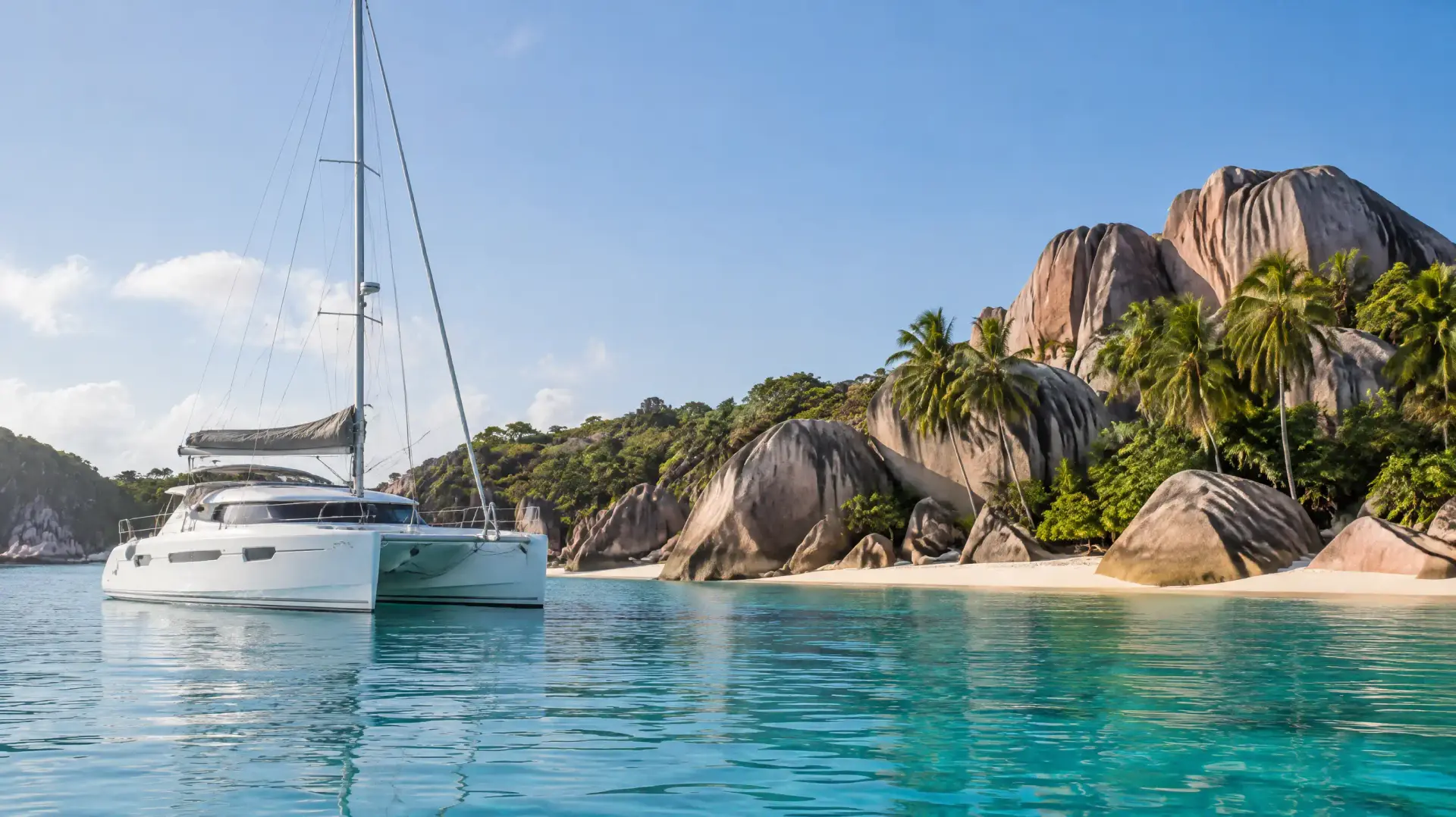
A week on a catamaran in the Seychelles is an island-hopping cruise between the granite islands of the Indian Ocean, sleeping on board, with stops at Mahé, La Digue, Curieuse, Cocos, Praslin, Grande Soeur and Sainte Anne. There are only two long passages of 3-5 hours each; the rest take from half an hour to a couple of hours. Our departures are in November and February, months of light wind, when the Seychelles Meteorological Authority describes conditions at sea as fairly calm.
What follows: a day on the boat, the islands one by one, the seasons and the costs on top of the Seychelles tour price.
What a week on a catamaran looks like
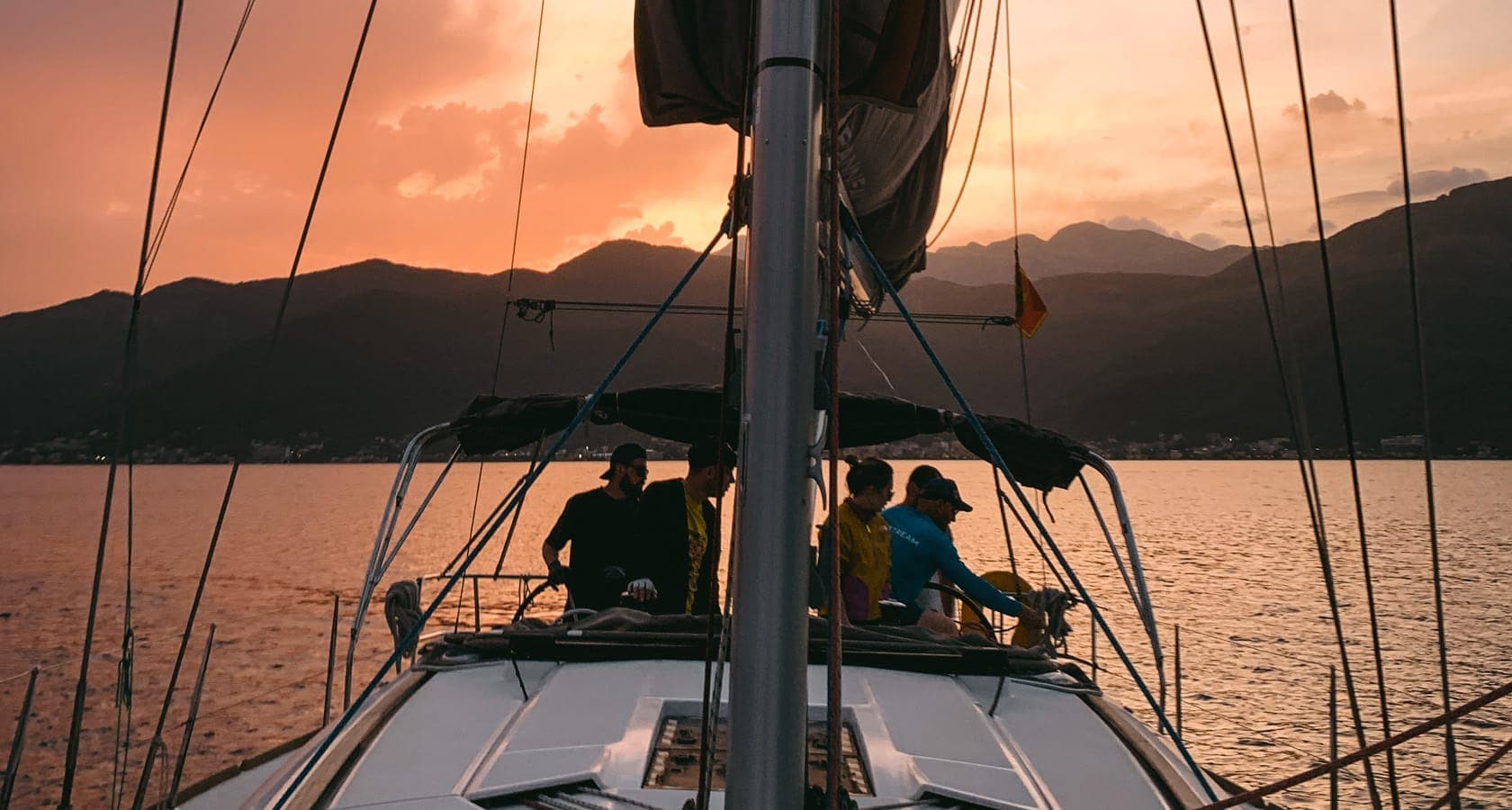
Each day of the route brings a new island: a passage during the day, swimming and snorkelling, the dinghy to get ashore, and a night at anchor in a bay. You sleep in a double cabin; on board there is a kitchen, air conditioning and 230 V sockets. The skipper sails the boat, so no sailing experience is needed, and basic sailing instruction during the week is included in the price.
Our tour programme:
- Mahé. We meet at Eden Island marina next to the capital, Victoria, check in, have a safety briefing, shop for provisions and have dinner at the marina.
- La Digue. The first long passage, with a line out for tuna on the way. We spend the evening at anchor.
- Curieuse. The island of giant tortoises; we spend the night in a bay off the island.
- Cocos. The main snorkelling day, plus another beach.
- Praslin. The palm forest of the coco de mer, then sunset at anchor again.
- Grande Soeur. A private island that yachts may visit only at set hours.
- Sainte Anne. We head back towards Mahé and anchor off the Sainte Anne marine park to spend the last evening in the water.
The route depends on the weather: the skipper picks the safe option and may change the order of the islands.
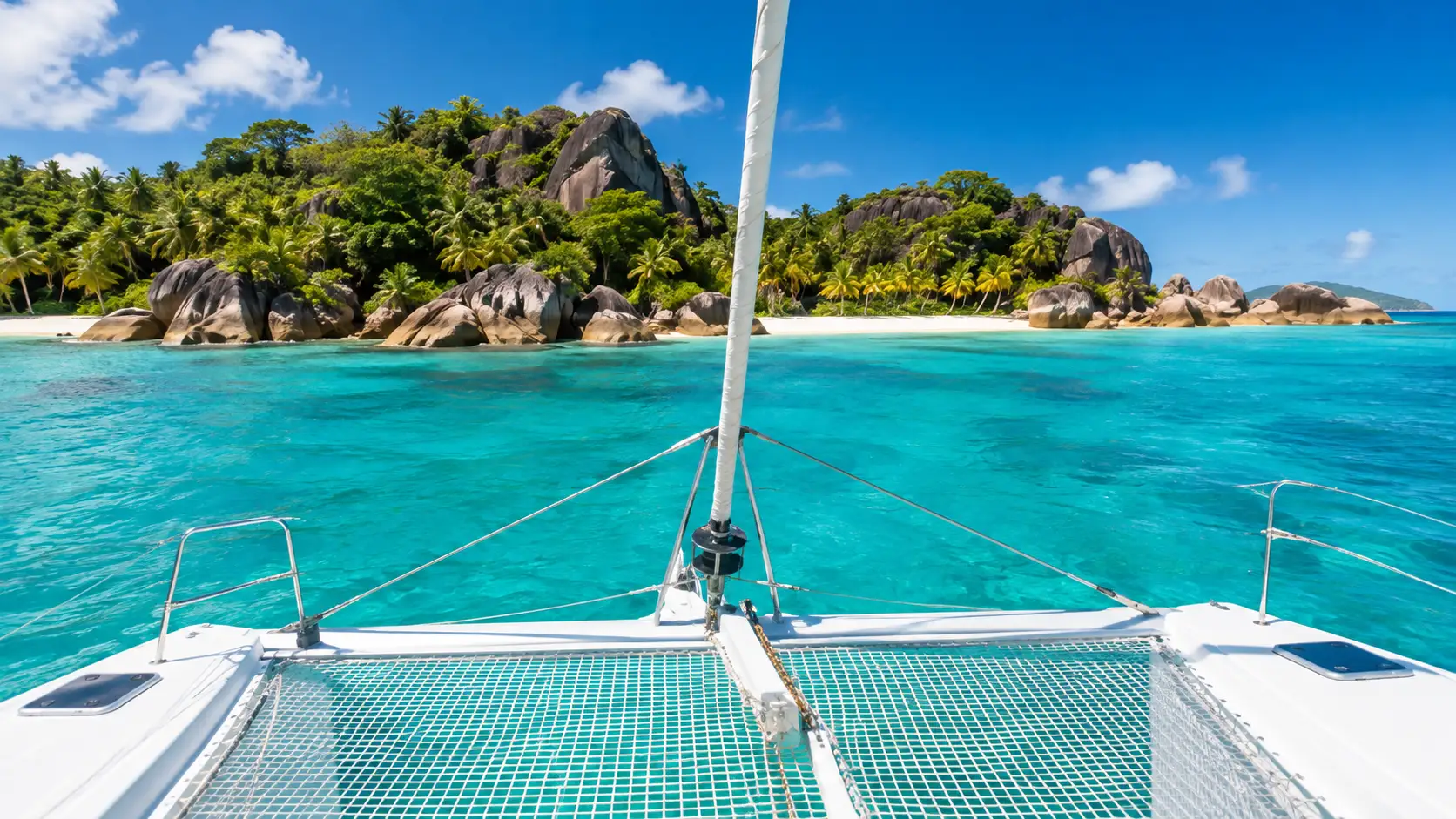
The islands on the route
The route covers two groups of islands. Mahé and Sainte Anne lie in the south, while Praslin, La Digue, Curieuse, Cocos and Grande Soeur are about 40-50 km to the north-east.
| Island | Why go | Good to know |
|---|---|---|
| Sainte Anne | The first marine national park in the Indian Ocean, created in 1973, about 5 km from Mahé. Seagrass meadows and green turtles | Park entry is paid from the boat kitty |
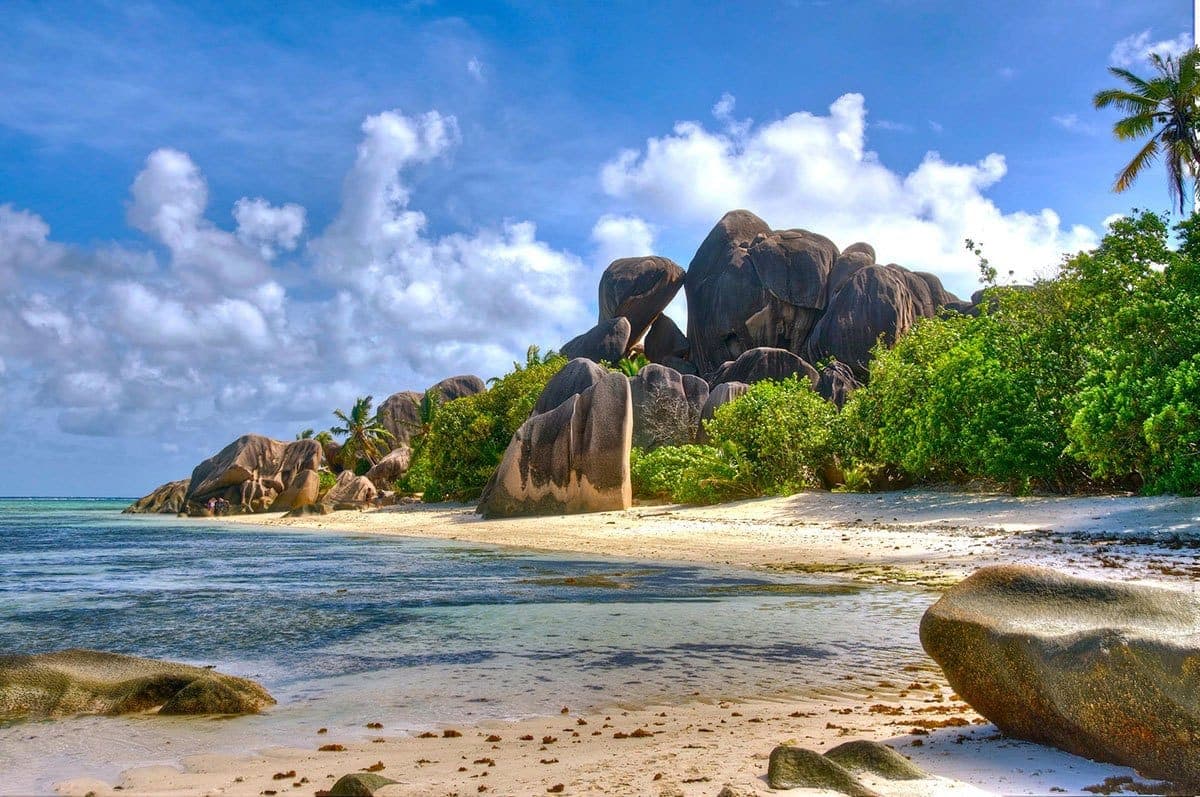
| La Digue | The granite boulders and beaches from most Seychelles postcards | Anse Source d'Argent beach is inside the L'Union Estate park; entry is covered by the boat kitty |
| Curieuse | Hundreds of giant tortoises brought here in 1978-1982 and a mangrove boardwalk. Coco de mer grows in the wild only here and on Praslin | From October to early March a sea turtle nesting trail is open |
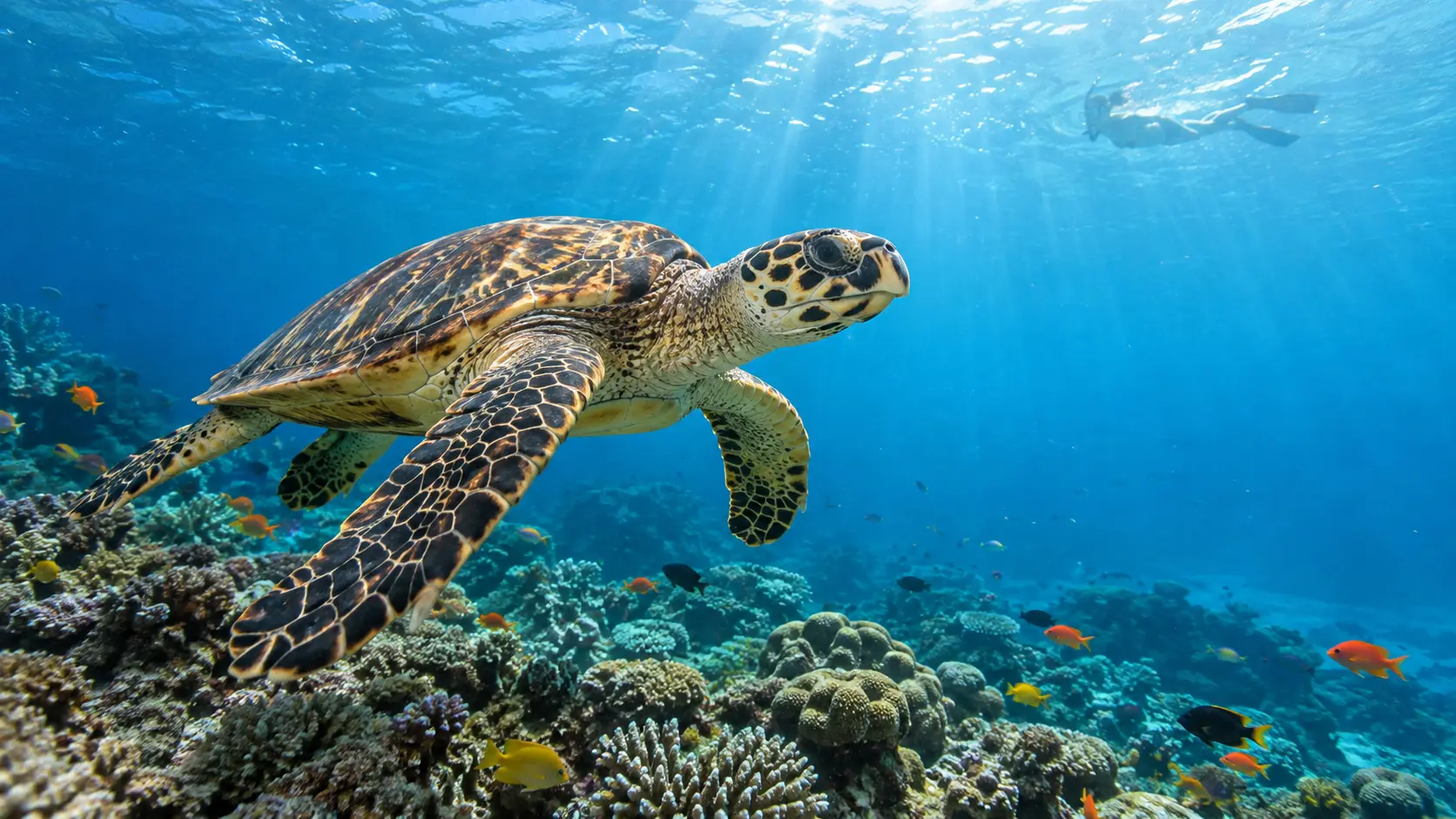
| Cocos | The parks authority calls it the most renowned snorkelling spot in the Seychelles: hawksbill turtles and reef fish | Marine park, entry covered by the boat kitty |
| Praslin | Vallée de Mai, a UNESCO World Heritage Site since 1983: a palm forest with the largest seed in the plant kingdom | Open 8:30-16:30, entry covered by the boat kitty |
| Grande Soeur | A private island owned by a hotel on Praslin | Open to yachts on weekdays during the day only, closed at weekends |
Entry to the marine national parks and nature reserves on the route, including Vallée de Mai and L'Union Estate, is paid from the boat kitty, so there are no entry tickets to buy on site.
When to sail the Seychelles
You can sail here all year, but wind and swell change a lot with the seasons. The calmest sea comes in the transition months, April and October-November, and the wind is also light from December to March. July and August are the peak of the south-east trade wind; of August, the Seychelles Meteorological Authority writes that the sea is "certainly forbidding for amateurs".
Seasons according to the Seychelles Meteorological Authority:
| Period | Wind | What it means for a beginner |
|---|---|---|
| December-March | North-west monsoon, light, 5-6 knots on average | Calm sea, but this is the rainy season: around 400 mm falls in January |
| April | Change of winds, the lightest of the year | The calmest passages, hot |
| May-September | South-east trade wind, 11-12 knots on average in July-August | More sailing and more swell; long passages are harder going |
| October-November | The trade wind eases and swings west | Calm sea, the rains return |
The average wind figures come from long-term data at the airport weather station for 1972-2005, and under sail or in gusts the wind can be noticeably stronger.
Sources disagree on the best season. The charter company The Moorings calls April to October the high season and the best time to book a cruise. The meteorological authority advises amateurs to stay close to shore in July, and for a first sailing trip we go with the meteorologists.
November. The wind drops significantly and swings to the west, the authority calls conditions at sea "quite pleasant", and the water is around 28°C. The rains set in, around 200 mm over the month on average, though there is still plenty of sunshine.
February. Rainfall eases, though the month is still humid at around 280 mm. The north-west monsoon still dominates, the authority rates conditions at sea as fairly good, and the water warms to about 29°C.
Seychelles: island-hopping cruise on a catamaran
DetailsWill I get seasick on a catamaran?
A catamaran moves more gently than a monohull: it has two hulls and hardly heels under sail. The catamaran builder Privilege Marine writes that its boats rarely heel more than 5 degrees, while a monohull routinely sails at 20-30 degrees. There is still some motion, and you may feel queasy on the two long passages between Mahé and the northern islands if there is a swell.
What the UK's National Health Service (NHS) recommends for motion sickness:
- stay near the middle of the boat and look at the horizon or another fixed point;
- do not read or use your phone during the passage;
- avoid heavy or spicy food and alcohol before and during the passage;
- try ginger;
- motion sickness remedies are sold at pharmacies, and a pharmacist or doctor can suggest the right one.
Most people feel worse in the cabin than on deck in fresh air. After a week on the water many people feel the floor swaying for a day or two; this is normal.
How much does a week cost: the full budget
The tour costs €1,500 for a berth in a double cabin or €2,800 for the whole cabin. On top of that, budget for the boat kitty, the environmental levy, flights, food and entry paperwork.
| Expense | How much | How it is paid |
|---|---|---|
| Berth / whole cabin | €1,500 / €2,800 | Tour price: accommodation, passages, boat insurance, programme, basic sailing instruction |
| Boat kitty: fuel, mooring fees, entry to the national parks and reserves on the route | about €150 per person | Separately from the tour price |
| Seychelles environmental levy for yachts | SCR 100 per person per night, about €43 per week | Separately; children aged 12 and under are exempt |
| Travel Authorisation | from €10 | Each guest applies on the official website |
| Flights to Mahé and a taxi to the marina | depends on your city and dates | Each guest books their own |
| Food | on day one we shop for provisions together; there is a kitchen on board | Separately from the tour price |
| Chef on board | on request | Optional extra |
The levy rate for yachts is SCR 100 per person per night under amendments in force from 1 January 2026; it is administered by the Seychelles Revenue Commission. Exchange rate on 9 October 2026, according to the Central Bank of Seychelles: €1 = SCR 16.25.
A guide to eating ashore: dinner for two at a mid-range restaurant on Mahé costs around €45, according to Numbeo in October 2026.
Bring a card that works internationally and some cash in euros: euros are widely accepted at hotels and tour companies, while rupees are handy at markets and small shops. Cash worth SCR 50,000 (about €3,000) or more must be declared in your Travel Authorisation application.
For a general breakdown of what a yacht tour costs, see our article How much does a yacht tour cost.
Getting to the Seychelles and entry requirements
Visitors of all nationalities enter the Seychelles without a visa, but you need an electronic Travel Authorisation in advance. On arrival you get a free Visitor's Permit for up to three months.
- Book a flight to Mahé. Emirates flies via Dubai, Qatar Airways via Doha and Turkish Airlines seasonally from Istanbul. There are no direct flights from Tbilisi, so from Georgia you connect through one of these hubs. Check the schedule on the airline's website before booking.
- Get a boat accommodation document from us. The Travel Authorisation requires a booking with the boat's name and dates; we issue it to every guest.
- Apply for the Travel Authorisation on the official site, seychelles.govtas.com. You can apply no earlier than 30 days before arrival. Standard processing within 24 hours costs €10; faster options cost €30 or €70. Unofficial third-party sites may charge more for the same thing. Without an approved authorisation there is a €30 penalty on arrival.
- On arrival show your passport, return ticket and booking: border officers issue the Visitor's Permit free of charge.
- Take a taxi to Eden Island marina. Guests fly in from different countries at different times, so there is no group transfer. The marina is next to the capital, Victoria.
What to pack for the Seychelles and what not to take home
Pack the usual kit for a yacht week, listed in our packing list for a yacht tour, plus five things:
- cash in euros for the week;
- a dry bag for your phone and documents: we go ashore by dinghy and spray is unavoidable;
- a mask and snorkel;
- sunscreen without oxybenzone: there is no official ban in the Seychelles, but such creams are kinder to the reef;
- a light rain jacket if you travel in November or February.
In the marine parks you may not collect shells, coral or plants, or fish. Exporting coral, shells and plants from the Seychelles is restricted by law. You can take a coco de mer nut home only if it was bought from an official seller with a certificate.
Who a catamaran week is not for
A catamaran week suits people who are happy to share a boat with a group and love being in the water. If hotel comfort matters more to you, a hotel on Praslin or La Digue is the better choice.
Before you book:
- The cabin is small. There is less space than in a hotel room, so pack in a soft bag.
- Long passages. Two passages of 3-5 hours mean time on deck with limited connectivity and no going ashore.
- The weather decides. November and February have rainy days, and the skipper may change the order of the islands or stay in a sheltered bay.
- The group. A group tour brings together people from different places. You can come on your own: book a berth and your cabin mate will be another guest.
FAQ
Do I need sailing experience?
No. The skipper sails the catamaran and teaches the basics of sailing during the week; this is included in the price. More in our article Yacht tours for beginners.
Do I need a visa for the Seychelles?
No visa is needed. Apply in advance for an electronic Travel Authorisation at seychelles.govtas.com; on arrival you get a free Visitor's Permit for up to three months. We provide the boat accommodation document for the application.
What is the weather like in the Seychelles in November?
Hot, around 29°C during the day, with water at about 28°C. The wind drops and the meteorological authority describes conditions at sea as quite pleasant. The rainy season begins in November, but there is still plenty of sunshine.
What is not included in the tour price?
Flights and a taxi to the marina, food, the boat kitty of about €150 (fuel, mooring fees and entry to the parks and reserves on the route) and the Seychelles environmental levy of about €43 per week. A chef can be added as an optional extra.
Can I come on my own?
Yes. You can book a single berth in a double cabin for €1,500; your cabin mate will be another guest on the tour.
Seychelles: island-hopping cruise on a catamaran
Details